


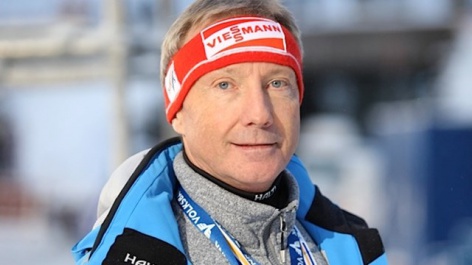

In our series "FIS Ski Jumping-Talk" we present interviews with ski jumping athletes and officials. Today: Walter Hofer, FIS Race Director.
Walter Hofer (60) is the Race Director in the ski jumping World Cup since 1992. With Berkutschi, Hofer spoke about the last summer and also looked ahead to the upcoming World Cup season.
FIS Ski Jumping: Walter, how would you sum up the last FIS Grand Prix season?
Walter Hofer: From a sporting point of view we saw great competitions. We also had some new organizers, who proved that they are ready. It showed that there was an even broader field of competitors. Even if the one or the other top athlete is not participating, there's still no negative feedback. Because the athletes, who are taking part, still show a competition on the highest level. And it is to be expected, that some of the athletes, who were successful in summer, will also be among the best in winter.
FIS Ski Jumping: What do you think about the possible role of the Japanese, who were very strong in summer?
Hofer: They are experiencing a generation change. Besides Noriaki Kasai, there are one or two other older athletes and now also a group of young jumpers. They will try to keep jumping on the level they showed in summer. I think they will be competing at the world-class level.
FIS Ski Jumping: There were some critical voices addressing the fact that some of the top athletes barely competed this summer. What is you opinion about that?
Hofer: You have to look at the whole picture. We use the summer intensively to test new things. The summer is kind of like our laboratory (laughs). But of course it's true that, especially in Asia, some athletes always decide not to compete. Otherwise we would have to carry out a qualification there as well. With the larger number of very good athletes in the different nations, this problem will solve itself. We are very satisfied with the organizers there. And the teams will send there athletes there again, also because of the quota regulations. I consider it a transition phase. At the same time the current situation provides the opportunity for a bit weaker teams to score important points that will guarantee them that the travel costs are covered for two years. This is a lot of money and it is of high importance for athletes like Zografski, the Americans or the Canadians. That's why I think it's good that they are getting this chance.
FIS Ski Jumping: You mentioned that there are new organizers in summer. Which venues are you thinking about exactly?
Hofer: Nizhniy Tagil, for example, is now included in the World Cup calendar. Almaty will also get the chance this year, but next year there will be no competition there due to the Asia Games. In Almaty they also have a great cross country track around the stadium. Chaikovsky is basically ready for a World Cup, also Sochi is also knocking at the door. It will be on the Russian Ski Association to decide, where the events shall take place. I think that we have met our target for Eastern Europe and the Far East. It the next five to six years it will now be about re-establishing the sport in North America. This is a core region to where we want to return with events on the highest level.
FIS Ski Jumping: Concerning the USA, do you see the opportunity to first start with the ladies there? From a sporting point of view the US women are more successful than their male colleagues.
Hofer: But in practice it looks different. The USA had an overall World Cup winner, a World Champion and a medalist at World Championships in ladies' ski jumping, but so far there was no application of the national ski association to host a competition in the USA.
FIS Ski Jumping: Let's look ahead to the next season. What can the ski jumping fans look forward to?
Hofer: Like already last year, there's a tight calendar again. At first we wanted to leave one weekend open, but we could not do that. With Willingen a very big organizer applied to host an event on a weekend right after the 4-Hills-Tournament. We will use that in the best possible way. There was also the chance to move the competition in Wisla, that was originally planned during the week, to a weekend. So it's not that tight, but still full of highlights. It's similar to last year.
FIS Ski Jumping: How is the current situation in Zakopane?
Hofer: Totally relaxed. The certificate for the hill is still valid for the upcoming season. After that the facility will be completely renovated. That has already been agreed on.
FIS Ski Jumping: The calendar draft for the 2016/17 World Cup was published after the recent fall meetings of the FIS. Why is the World Cup opening planned to be held in Titisee-Neustadt then?
Hofer: We suggested the German Ski Association to organize it in Klingenthal. Klingenthal needed some security in the planning so we agreed to carry out the World Cup opening there three times in a row. We want to keep the season opening in Germany, but it's on the national ski association to name the venue. As long as the venues are on a comparable level, making the choice is completely up to the national association.
FIS Ski Jumping: Thanks for the interview and all the best for the new season.
Source: fis-ski.com