

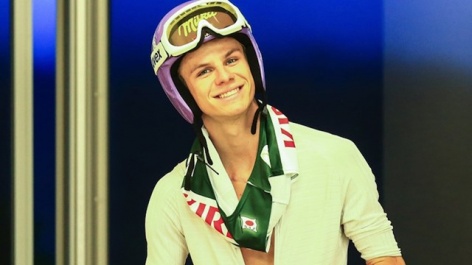

Despite his young age, Andreas Wellinger has already experienced the ups and downs of his sport like few others. High-flyer, World Cup winner, team Olympic champion, team silver medalist at Ski Flying World Championships, golden boy, fan favorite. The always positive athlete of the club SC Ruhpolding presented himself in a great shape this summer and is now facing a decisive winter season. We spoke to the likeable Bavarian.
FIS Ski Jumping: Andreas, congratulations on your second place in the Grand Prix 2016. You achieved great results this summer, among which a win in Hinterzarten. How important are these results in summer and the competition series in general?
Andreas Wellinger: Of course it gives you an extremely good feeling when you are already among the best in summer. But I think that you can't really compare the summer and winter season. I'm happy about the second place, because my performances were consistent all summer long. In the most recent competitions I was close to the podium. In Klingenthal I knew what mistakes I've made, the 14th place there was still okay. That's why these competitions are a good indicator.
FIS Ski Jumping: You celebrated one win in the World Cup so far, in Wisla in January 2014, and were second three times, in 2012 (Engelberg) and 2013 (Engelberg and Klingenthal), you won gold in the team competition at the 2014 Olympics in Sochi. Then you crashed in Kuusamo in December 2014 and you were sidelined for almost the entire 2014/15 winter season, even if you were able to compete in the final World Cup events. Were you able to get this crash out of your mind?
Wellinger: I think you can never get something like this out of your mind completely because it's such a drastic experience. I would say that it doesn't affect me anymore. I'm also convinced that often you learn a lot more from negative things than from positive ones because you know how it doesn't work and you react differently if you're in a similar situation again. The crash was mainly my own fault. That's why I think that, in the long-term, I can benefit from it. In this situation it was of course bad, but it was "only" a collar-bone injury and in ski jumping that doesn't force you to take an extremely long break. That's why I got better relatively fast. You learn and gain experiences that can help you in the long run.
FIS Ski Jumping Simon Ammann once said: Ski jumping is not dangerous, when your system is stable. This is also your opinion, right?
Wellinger: Exactly. The conditions don't matter when the body-ski system works and is stable. Then it doesn't matter if you are a bit late at the take-off or if there's a bit more wind. You just have to look at Peter Prevc last winter. He was simply the athlete with the most stable system and that made him so extremely successful.
FIS Ski Jumping: Our FIS Ski Jumping expert looked at your jumps this summer and said that you are jumping extremely stable. He thinks you were very strong and on a very high level technically. He says that you are now in the right age and have the right amount of experience. In his opinion we will see you on the podium a lot in winter and he's convinced that you can be very successful. Is this realistic?
Wellinger: That's a great praise, but I have to prove it first. I think that I made a step forward this summer, also towards having a more stable jump in order to have less ups and downs concerning the performance and the results. If it's already enough for me to consistently fight for wins and podium finishes this winter? We would have to talk about this again on March 20th. Of course, this is the goal. Everyone who's competing wants to win. Sometimes you need a bit of luck, but you also need consistency and I think I improved this summer. I'll try my best to live up to this high expectations.
FIS Ski Jumping: But it's correct that you are even better now than you have been in the past few years?
Wellinger: I would say so, but we will know it for sure after the winter. I tried to stabilize my jumps in summer, so I'm able to be among the best until the final competition in March. In the recent years I always had a downward trend in late January, early February. Now I'll try to remain on a high level for a longer period of time.
FIS Ski Jumping: Your purple helmet is kind of a special honor because for some wearing this color makes you the successor of Martin Schmitt. Do you think you are, or does it not matter to you at all who was the only one who wore this purple helmet before?
Wellinger: It's definitely an honor for me. I'm the only man who gets to wear a purple helmet and there are also only a few ladies' in alpine skiing, who wear it. But I don't look at myself as the successor of Martin Schmitt, as was often written at the beginning. He is a different kind of person than I am and it's been a while since his heyday. Back then I was still a child and just started ski jumping. But of course he's an idol and wearing such a symbol is an honor for me. If I should ever be in a situation where I can say that I was as successful as he was, I think I could be very, very satisfied. A lot has to happen until then. I would already be satisfied if I could get even close to this. Luckily I still have some time left to achieve it.
Source: fis-ski.com