


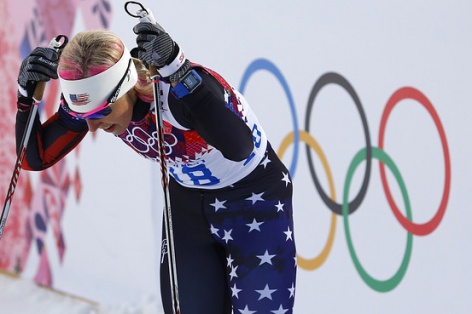

It also started a bizarre series of events that may have ruined her shot at a groundbreaking medal.
One of the great mysteries of Sochi—and Team USA’s biggest individual disappointment there—is what happened to Randall, who was expected to win America’s first cross-country medal since 1976. As the two-time reigning World Cup sprint champion, she looked like a lock to make the podium in the freestyle sprint, if not win the gold. Instead, Randall didn’t even make it out of the event’s quarterfinals.
It gets worse. The freestyle sprint, Randall’s signature event, won’t be held again until the 2022 Games. By then, Randall will be 39 and likely retired.
After the Olympic race, Randall choked back tears as she left the stadium above Krasnaya Polyana, with few knowing how a seemingly harmless scavenger hunt on skis led to a cascade of misfortune that cost her an Olympic medal.
“It was sort of like a perfect storm of a lot of little things that didn’t go quite right,” Randall said last week from Park City, Utah, where she is participating in high-altitude training for an upcoming season that she nearly decided to skip.
That storm began the day before her birthday, when she set out across the sparkling Landwasser Valley. Initially, Randall had mapped out a moderate, two-hour training session, but she ditched that plan to embark on the hunt.
Three hours later, Randall was cold, tired and still a clue away from finishing the hunt. A half-hour after that, she collapsed in her hotel room, exhausted from the venture, which stretched her workout 90 minutes longer than she had planned. The scavenger hunt, which involved a series of clues that led all throughout the hilly terrain around Davos, was so hard for Randall because she specializes in sprints and doesn’t normally ski for 3½ hours straight.
The next morning Randall clicked into her skis and began to windmill her arms to warm up her hands. Almost instantly, her back went out. Still tight and sore from the day before, she had strained the fibers around the discs in her lower spine.
At first, she struggled to stand up. Then she forced herself onto the trails. She lasted 10 minutes.
“She does such a good job of maintaining that balance of performing as a professional athlete and having a life,” said Erik Flora, Randall’s longtime coach. “Who would have thought something like that could lead to a back injury?”
The injury didn’t keep Randall off the snow for long. Heat and massage therapy had her back on her skis within days, but the tenderness forced her to lower her intensity dramatically. A schedule filled with difficult interval sessions got replaced with the kind of easy skiing that wasn’t supposed to happen until a tapering period just before the Olympics.
The rest allowed Randall to be stronger than her competition in mid-January, when she won in the Czech Republic and Poland. But in Italy in early February, during her final tuneup before the Olympics, she felt fast out of the gate, then ran out of gas when she reached her highest gears. She finished fifth.
Randall arrived in Sochi feeling out of sync. The early January rest had made her peak too early. Her conditioning wasn’t where it was supposed to be.
Then came the bright, warm sun of the Caucasus Mountains and temperatures in the 50s and 60s. A brutal opening hill that was supposed to be hard and slick—allowing Randall to use her power to open up a lead—turned into a far easier climb on slushy snow. In her quarterfinal heat, she entered the stadium in position to advance. But when she reached for that last gear in the final straightaway, it still wasn’t there. She missed advancing to the semifinals by five hundredths of a second, or about the length of her big toe.
“There’s a reason Olympic medals are so special,” Randall said, “and it’s because they aren’t guaranteed.”
In March, Randall clinched her third consecutive season sprint championship, but even that victory was bittersweet. The fastest skier on the planet the past three years didn’t have an Olympic medal.
When training for a new season began in May, Randall began to waffle about whether the time had come for a longer break. Nordic training is as punishing as anything in sports, a series of hyper-intense, nausea-inducing three-week cycles that allow for little flexibility. “The work is straightforward,” said Flora, her coach. “The hard part of it is training hard every day.”
And there was another matter that male athletes don’t have to deal with: Randall and her husband, Jeff Ellis, who works with FIS, the international skiing federation, want to start a family before the hard push for the 2018 Pyeongchang Olympics begins in 2016. “I needed to think about what I really wanted out of skiing,” Randall said.
What she wants is an Olympic medal, and despite her season-long championship, the 2013-14 campaign had left a bad taste in her mouth. She decided she needed to push hard for one more year, then take what she hopes will be a maternity break, knowing that biology and luck could make a mess of those plans.
Along the way, Randall also will have to turn herself into a top classical skier, the sprint discipline in the 2018 Olympics. (The Games alternate between classical and freestyle each Olympics.) She isn’t a natural at the classical technique, which requires skiers mostly to keep their skis in parallel tracks throughout the race. Randall rarely makes the podium when she can’t freestyle ski, or skate, as the style is known. That is the style that most children raised on the hard-packed tracks around her home in Anchorage, Alaska, first perfect. Classic is far more technical, requiring metronome-like timing, body positioning and coordination that can’t be compensated for with mere power.
Her attempt to morph into a classic champion will begin in earnest in mid-November, when she heads to Europe to begin the next season. If she does make it to Pyeongchang in 2018, she won’t likely be a favorite.
Maybe that can work in her favor this time around. She knows better than anyone that Olympic medals are special because they aren’t guaranteed.
Source: online.wsj.com