


The last World Cup race before the very short Christmas break – a men’s night slalom – is taking place this evening in Madonna di Campiglio, a very esteemed Italian resort known by the fans for its long tie with the World Cup tour and by tourism experts for some of its most historical days, when that beautiful region was part of the Austro-Hungarian Empire.
Located within the ‘Dolomites della Brenta’ mountains located an hour west from Trento and two hours north from Brescia, Madonna di Campiglio is considered as one of the most elegant ski resorts in this part of the country with its imposing palaces and its nice shops boarding the main street.
Foreign visitors already enjoyed the stunning view from the highest peaks overlooking the area in the middle on the 19th Century after a first hostel was erected by a rich local business on the foundations of an old convent constructed at the end of the 12th Century. He also built a road to better access the location from the nearby village of Pinzolo, attracting some famous travelers as the Emperor Franz Josef from Austria and his attractive wife Elisabeth ‘Sissi’ who often came here during summer from 1889 to 1894 to relax, hunt or walk around for hours.
In 1910, English tourists also discovered the region and cruised down the Mount Spinale in winter with their long wooden skis yet winter sport tourism only took off in the 1930s when a better road was made by the Italian state and the first of several ski lifts put into operation on the modest ‘Belvedere’ slope.
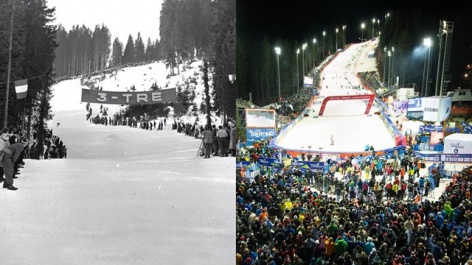
Mass tourism really started in the post-war years when more lifts were built, inciting the local ski club to launch an international ski event named “3-Tre” first organized in nearby resorts. Since 1957 it takes regularly place in Madonna di Campiglio allowing famous champions as Austria’s Skiing Legend Karl Schranz or Olympic Champion Egon Zimmermann to celebrate many victories in downhill, slalom or giant slalom.
A World Cup stage was already organized here in 1967 – with France’s Guy Perillat winning the slalom. The “3-Tre” event soon became a regular stop on the World Cup circuit and a eminent highlight in December since 1972. That year, a 18-year-young Italian from Piedmont upset once more all the favorites in slalom a week after his maiden victory in giant slalom at Val d’Isère in his first ever World Cup start - the 1974 overall World Champion Piero Gros who wore bib 45 in both races!
The location got also famous in Sweden after Ingemar Stenmark’s first World Cup win in December 1974 when the 18-year-old racer from Tarnaeby, only 22nd in the first leg, beat the rest of the field with an impressive second run. With a total of eight victories in slalom and giant slalom, Stenmark remains the great dominator on the ‘Miramonti’ slope where races in all specialties including parallel slalom, took place in past decades.
Other established ski heroes also excelled in Madonna di Campiglio, such as the 1976 Olympic Champion Franz Klammer, who clinched a downhill race here in December 1975, while Marc Girardelli or Pirmin Zurbriggen were the best in some Super-Gs in the mid 1980s. Later on, huge crowds of nearly 20,000 spectators stood at the arrival and along the slalom course in the great days of Italy’s Skiing Legend Alberto Tomba from 1987 to 1996.
The winners list include the names of most top-slalom specialists in recent years including Finn Christian Jagge, Bode Miller, Mario Matt, Ivica Kostelic, Marcel Hirscher, Felix Neureuther and Henrik Kristoffersen, the defending slalom World Cup champion, confirming the position of the ‘3-Tre’ as a true ski ‘Classic’.
Source: fis-ski.com